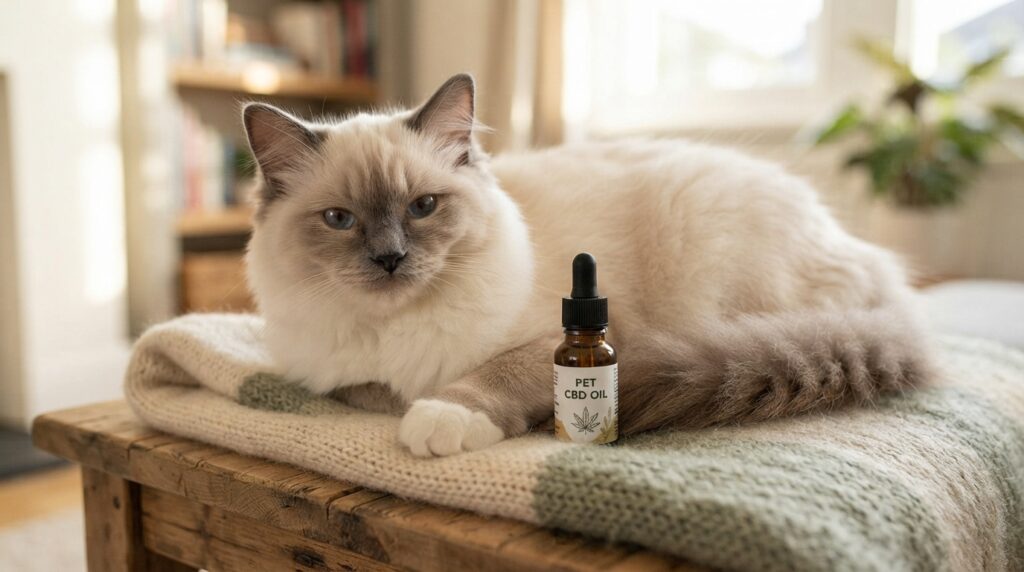
The jump onto the couch used to take one smooth motion. Now there is a pause, a wiggle, and sometimes a decision to stay on the floor. Owners of older cats tend to notice these small changes first.
That shift is what sends many people looking at CBD oil for cats in their later years. Shelves and websites present it as a gentle answer to stiffness, and the idea is easy to like. Reality is more layered, and a few facts help sort what is promising from what is promotional.
This guide looks at how aging shows up in cats, what is known about CBD in that setting, and which steps have stronger evidence behind them.
Aging Cats and Quiet Pain
When a Cat Counts as Senior
The 2021 life stage guidelines from the American Association of Feline Practitioners (AAFP) and the American Animal Hospital Association (AAHA) place cats aged 7 to 10 in the mature adult stage, 11 and up in the senior stage, and cats past 15 in the geriatric stage. Age alone does not decide health, but it does shift what a vet looks for.
Cats in the senior stage should see a veterinarian about twice a year, according to AAFP guidance. Six months is a long time for a cat who hides discomfort.
Pain Hides in Plain Sight
Cats evolved as both predator and prey, and showing weakness was risky. Many still mask pain well into the point where it affects daily life.
Signs that owners often mistake for slowing down:
- Skipping jumps that used to be easy
- Missing the litter box edge or going just outside it
- Less grooming, with a matted or greasy coat along the back
- Sleeping in new places, usually lower and closer to the floor
- Irritability when picked up or petted near the hips
Any of these merits a vet visit before a supplement purchase.
Joint Disease Is Common
X-ray studies of older cats have found degenerative joint disease in a large share of them. A frequently cited 2002 study in the Journal of the American Veterinary Medical Association reported signs in about 90 percent of cats older than 12.
Many of those cats never limp. Their pain shows up as behavior change, which is why a checklist of habits tells a vet more than a quick look at the gait.
Where CBD Fits, and Where It Does Not
What Is Known
Most of the encouraging data come from dogs. The 2018 Cornell study in Frontiers in Veterinary Science followed 16 dogs with osteoarthritis and reported that owners and vets saw improvements in comfort and activity on a CBD oil. The study was small and short, and a placebo comparison would be needed to say more.
Cats are not covered by that research. Studies of CBD in healthy cats have focused on absorption and tolerability rather than on arthritis relief.
What Is Not Known
Nobody has established a feline dose for pain, the right length of treatment, or how CBD interacts with the medications many senior cats take. Kidney disease, hyperthyroidism, and heart conditions are common in older cats, and each can change how the body handles a supplement.
When the person selling a product claims a precise answer to any of those questions, the claim is running ahead of the evidence.
Options with Stronger Backing
In January 2022 the FDA approved Solensia (frunevetmab), a monthly injection given by a vet to control osteoarthritis pain in cats. It was the first approval of its kind for that purpose in cats. Veterinarians also use prescription pain relievers chosen for a cat’s kidney and liver status.
Weight management belongs on the list as well. Every extra pound adds load to sore joints, and a modest weight loss plan can make a visible difference in movement.
Making a Senior Cat’s Home Easier
Ramps, Steps, and Soft Landings
Pet-safe ramps or sturdy steps beside the couch and bed cut down on risky jumps. A folded blanket on a low window ledge gives a sunbather an easier climb.
Non-slip mats on hard floors help cats with weak hindquarters keep their footing. Small fixes like these cost little and show results the same day.
The Litter Box Problem
High-sided boxes become obstacles. A box with a low entry, or a shallow baking tray with unscented litter, lets an arthritic cat step in comfortably.
Place boxes on every floor of the house. A cat that avoids a box is often telling the owner something about pain, not behavior.
Food, Water, and Warmth
Raise bowls slightly if bending is hard, and offer water in more than one spot. Heated beds designed for pets can ease stiffness on cold mornings, as long as the cat can step off whenever it wants.
A vet can also advise on diets and supplements with better-known track records, such as omega-3 fatty acids from fish oil in joint-focused diets.
If a Vet Agrees to a CBD Trial
Set Up the Trial Properly
Baseline bloodwork comes first, followed by one change at a time. Adding CBD while swapping foods or starting a new medication makes any result impossible to read.
Run the trial for a defined period, often four to eight weeks, and agree on what counts as success before starting. Stopping is a perfectly good outcome if nothing improves.
Track Comfort with a Tool
Questionnaires help turn impressions into numbers. The Feline Musculoskeletal Pain Index, developed at North Carolina State University, asks owners to rate how well a cat performs activities such as jumping, running, and climbing stairs.
Fill it out before the trial and again at set intervals. The pattern over time tells more than any single day.
Final Thoughts
Older cats deserve a thorough exam before any new supplement enters the picture. Evidence for CBD in feline arthritis is thin, while other options carry more data. Home changes such as ramps and low litter boxes help immediately. A vet can decide whether a monitored CBD trial belongs in the plan.